Showing posts with label non-fiction. Show all posts

Sunday, September 28, 2008

BOOK REVIEW: The Mural at Waverly Inn by Edward Sorel and Dorothy Gallagher

The Waverly Inn, a landmark of New York’s Greenwich Village since the 1920’s, was purchased by Vanity Fair editor Graydon Carter in 2006. The refurbished restaurant became a beacon for cognoscenti since it was reopened, in part for Edward Sorel’s dazzling mural covering its walls.

If the style of the artwork on the cover feels familiar it may be because you’ve come across Sorel's drawings in The New Yorker. A regular contributor to the famous magazine, he was commissioned by Carter to create the bacchanalian scene for the restaurant. Mining 150 years of Greenwich Village history, Sorel selected 43 luminaries to cavort in the hedonism of his never-ending party.

The Mural at the Waverly Inn: A Portrait of Greenwich Village Bohemians features Edward Sorel’s mural as a foldout at the back of the book. The pages of this hardcover volume feature each of the bohemians cropped out of the mural, accompanied by pithy mini-biographies written by Dorothy Gallagher. Here you’ll see Truman Capote as a butterfly attacking Walt Whitman and be reminded of Capote’s indulgence in drugs and alcohol. Norman Mailer lies on the banks of a reflecting pond in a pose reminiscent of Narcissus while Anais Nin cavorts nude, and Jack Kerouac furiously types on his novel. Other luminaries include Djuna Barnes, Joan Baez, Edna St. Vincent Millay, Thelonius Monk, Bob Dylan and Andy Warhol to name just a few.

If you can’t get a reservation at Waverly Inn, this charming coffee table book is the next best thing. At 56 pages, The Mural at the Waverly Inn is a small treasure to be sampled and savored at leisure.


ISBN13: 9780307377319
ISBN10: 0307377318

Hardcover
56 Pages
Publisher: Pantheon
Publication Date: October 28, 2008


tags:

Sunday, October 01, 2006

BOOK REVIEW: The City of Falling Angels by John Berendt

In 1999 John Berendt shot into the limelight with Midnight in the Garden of Good and Evil, a book that won him an unprecedented four-year run on the New York Times bestseller list. Seven years later, Berendt presents readers with his long-awaited second book – The City of Falling Angels.

What readers enjoyed most about Midnight is Berendt’s ability to capture a sense of place with words. Readers felt as if they had traveled to Savannah, investigated the mystery themselves and knew the eccentric denizens intimately. Berendt’s legion of fan will be delighted to know that his familiar tone graces The City of Falling Angels, and readers will be quickly captured by the charms of Venice.

City opens on the evening of January 29, 1996, the night a devastating fire destroys the historic Fenice opera house. This catastrophic loss is soul-destroying for many Venetians and, fortuitously arriving in Venice three days after the fire, Berendt chronicles the aftermath.

While peripherally an investigation into the causes of the Fenice fire, really this event only provides Berendt the setting, around which to wrap a chronicle of the characters he meets in Venice. Once again, Berendt appears to be a magnet for the eccentrics, whom appear drawn to any notorious city. As Berendt hunts for the key players to help him understand the political dynamics shaping the reconstruction of the Fenice, he uncovers the love/hate relationship many Venetians feel for their city – and the constantly shifting political sands driving any major effort in Venice.

Venice is a city loved by many tourists and in City, Berendt explores the efforts many have made to save the history, art and architecture from the ravages of rising water and decay. In a post-9/11 world, many understand the symbolism a building can represent. Places tend to mean much more than just the daily uses citizens make of it. In the Venice of permanent residents, the Fenice is one of the few remaining buildings that is theirs, rather than the tourists’. Rebuilding it means restoring the soul of this magnificent city and Berendt brilliantly chronicles the political challenges complicating the task.

Read the review at Curled Up with a Good Book.


ISBN10: 0143036939
ISBN13: 9780143036937

Trade Paperback
416 Pages
Publisher: The Penguin Press
Publication Date: September 26, 2006


tags:

Saturday, September 30, 2006

BOOK REVIEW: Path of Destruction by John McQuaid and Mark Schleifstein

In 2002, John McQuaid and Mark Schleifstein wrote “Washing Away,” an award-winning series for the New Orleans Times-Picayune. The authors exposed the unique vulnerability of New Orleans to hurricanes, exploring “an obvious but little-acknowledged fact: here was a city that, for the six months of every hurricane season, lived with a substantial risk of utter annihilation…much of the city was built on top of a swamp, below sea level and gradually sinking.”

On August 29, 2005, Hurricane Katrina struck New Orleans and the Louisiana coast. In Path of Destruction: The Devastation of New Orleans and the Coming Age of Superstorms, McQuaid and Schleifstein revisit familiar territory, helping readers understand why this tragic event happened when there were so many warnings.

Path of Destruction outlines the factors that contributed to the tragedy in New Orleans. By 2005, many levees were still incomplete and those built had inadequate safety levels, with safety factors of 1.3 (bridges have a safety factor of 2). The Army Corps of Engineers were more interested in commerce than hurricane safety. When combined with sinking marshlands and unstable soil, these facts increased the likelihood that levees would be overtopped or broken by a Category 2 hurricane, turning much of New Orleans into a lake. Hurricanes sweeping in off the Gulf of Mexico no longer have extensive marshlands to diminish the storm’s strength for “the delta has collapsed like a soufflé.

McQuaid and Schleifstein also provide extensive evaluation of Katrina’s aftermath. Once the levees broke, 80% of New Orleans was under water and the delayed response by FEMA severely increased the misery caused by Katrina.

Despite the harrowing experiences of one year ago and the knowledge that what happened in New Orleans was “catastrophic structural failure” not an “act of God,” the US government is poised to repeat prior mistakes. The Corps is rebuilding levees to their former level of protection, leaving New Orleans as exposed as before Katrina. At one point, Corps contractors were caught “dredging up weak soil and incorporating it into a new levee.” Given the prediction of an increase in Katrina-like storms, the time to act and prevent future tragedies is now.

Read the review at Armchair Interviews.


ISBN10: 031601642X
ISBN13: 9780316016421

Hardcover
Pages: 384
Publisher: Little, Brown and Company
Publication Date: August 16, 2006


NOTE: I am working on a feature article for RiverWired.com (a new social networking site being launched in November) about the batch of books published on Hurricane Katrina this year. Further analysis of Path of Destruction will be included in that article, which I will post here once it is published.


tags:

Sunday, August 27, 2006

BOOK REVIEW: My Life as a Furry Red Monster by Kevin Clash with Gary Brozek

Few adults who had young children in 1996 will forget the Elmo fever that swept the nation as Tickle Me, Elmo become the “must have” toy of the Christmas season. Anyone who unfamiliar with the baby monster prior to the holiday season, quickly became aware of his red fur, contagious laugh, and the unprecedented fist fights which broke out between some parents desperate to buy the toy.

Few however, would have given much thought to the creator of that laugh. My Life as a Furry Red Monster: what being Elmo has taught me about life, love, and laughing out loud is the memoir of Kevin Clash, the puppeteer who has brought Elmo to life for almost 20 years.

My Life as a Furry Red Monster may be considered by some as a clone of All I Really Need to Know I Learned in Kindergarten or the Chicken Soup for the Soul books. Although it does contain many of the same life lessons and advocates seeing the world through the eyes of a child, Kevin Clash does more than just replicate Robert Fulghum’s best-selling work. Clash presents readers with a loving tribute to Jim Henson, Sesame Street, and the simple teachings which helped create the foundation for many readers' childhoods.

My Life as a Furry Red Monster celebrates joy, creativity and following your dreams wherever they may take you. For Clash, his delight in performing with puppets led him on a journey, the result of which was his work on Sesame Street. Being Elmo taught him a powerful lesson: the most fundamental power on earth is the human desire to love and be loved, a lesson which he hopes to share with the world in this new book.


ISBN10: 0767923758
Publisher: Broadway Books
Publication Date: September 2006
Binding: Hardcover
Author Website: www.kevinclashbook.com


tags:

Thursday, August 24, 2006

BOOK REVIEW: Grayson by Lynn Cox

On her daily, early morning swim off the California coast, 17 year-old Lynne Cox experiences fear for the first time. Energy fills the water and Cox herself as she is surrounded by a giant school of grunion that are being hunted by a small school of albacore tuna that try to sweep the young girl out of their way. Just as she is starting to get worried that she’ll get hit in the head by one of the forty-pound tuna, she realizes there is something very large in the water below her, something big enough to be a white shark.

“The water began shaking harder than before and I was being churned up and down as if I was swimming through a giant washing machine. The water shifted, and I was riding on the top of a massive bubble. It was moving directly up from below, putting out a high-energy vibration. I felt like there was a spaceship moving right below me. I had never felt anything this big in the water before.”

As Cox approached the pier, her friend Steve is jumping up and down, waving to get her attention, and shouting. “You can’t swim to shore…That’s a baby whale following you. He’s been swimming with you for the last mile. If you swim into shore, he’ll follow you…The weight of his body on the beach will collapse his lungs and he will die.” The 55°F water has already chilled her body during her hour training swim, but Cox must keep swimming with the three to four month old gray whale if she wants to help him reunite with his mother and pod. Grayson is the true story of how one teenage girl helps a baby whale find its mother in the vastness of the Pacific Ocean.

From this synopsis, most readers would expect Grayson to be fodder for the latest tear-jerker “movie of the week” or an inspirational kids’ movie. Grayson; however, is a memoir rather than fiction and shares a young woman’s dedication to helping a young calf reunite with his mother. Cox stays in the water with Grayson for hours, diving to extreme depths when she believes she’s lost him and swimming out far beyond her comfort zone to an oil-rig, where the whale pod was last spotted.

Cox writes eloquently about the experience, sharing her fears and her desire to give up, as well as the motivation she received from the Coast Guard staff, her friend Steve and Grayson himself. Her descriptions of the ocean and her experiences of swimming with schools of fish, a playful pod of dolphins, and finally Grayson’s mother, are evocative - so real that readers are able to feel the fish brush up against their legs.

Cox’s experience is motivational and, if she periodically ventures into verbiage that falls in the “self-help” realm, readers will excuse her, as the magic found in this small book easily makes up for a few lapses. What stands out most in Grayson is Cox’s deep love for the ocean and her gift to readers is her ability to share an experience few will ever have on their own.

Read the review at Curled Up with a Good Book.


ISBN10: 0307264548
Publisher: Alfred A. Knopf
Publication Date: August 2006
Binding: Hardcover


tags:

Sunday, August 13, 2006

BOOK REVIEW: Andean Folk Knits by Marcia Lewandowski

Marcia Lewandowski spent a total of eight years living in Bolivia during the 1980s and 1990s. During this period she developed a love for the hand-knit bags that the women wore as part of the traditional dress, and observed a decline in their usage as they were replace by mass produced items. In an effort to preserve the rich traditions represented by the patterns and colours of these traditional items, Lewanski “began a crusade which took me across five of the countries in the Andes Mountains collecting and recording the bags I found in the marketplace, in the countryside, in museums, and in private homes. I also listened to the stories and folklore associated with the bags I collected.”

The result is the wonderful resource Andean Folk Knits: Great Designs from Peru, Chile, Argentina, Ecuador & Bolivia. Lewandowski collected traditional design, patterns and colours and created the bags and other accessories included in Andean Folk Knits. The first section reviews the history of the Andean people and their traditional folk bags, including: the difference between llamas and alpacas and applications for each type of fiber; the different type and uses of traditional folk bags; and the meaning of the motifs used in their designs.

The subsequent sections each review the styles and colours typical of the knitting in each of the five countries. Sprinkled through, Lewandowski reflects on the natural features of the countries she visited during her travels, providing a window into the life in the Andean Mountains.

While the bags may not be patterns most people wish to carry, Andean Folk Knits is a wonderful addition to any knitter’s reference library. Lewandowski has provided charts for all the symbols and patterns used in her designs and these could easy be adapted for use on sweaters or other garments fitting a knitter’s personal style.

Read the review at Armchair Interviews.


ISBN10: 1579909531
Publisher: Lark Books
Publication Date: September 2006
Binding: Trade Paperback


tags:

Sunday, June 25, 2006

BOOK REVIEW: The Secrets of Judas by James M. Robinson

On July 1, 2004, the world was told that a new Coptic apocryphon had been discovered and was a copy of “the most condemned writing of antiquity: The Gospel of Judas.” First described by Irenaeus of Lyon around 180 AD, this document has been lost until it resurfaced in 1983. The text, in Egypt's ancient Coptic language, dates from the third or fourth century and is a copy of an earlier document, most likely written in 130 – 170 AD.

In The Secrets of Judas: the story of the misunderstood disciple and his lost gospel, James M. Robinson undertakes a review of the apostle Judas, as portrayed in the Christian gospels, and tells the story of the discovery and sale of this priceless piece of history.

Gospel means “Good News” and the gospels, as we now know them, were written for evangelizing rather than simply to inform. As such, they were not meant to be a historical record. Both Matthew and Luke contain sayings of Jesus that are not included in Mark, and therefore must come from another, earlier, source. Scholars believe that the document, now referred to as “Sayings Gospel Q,” was a compilation of sayings of Jesus still to be proclaimed. This document, composed only of quotes, was intended for use only by the disciples in their ministry and does not refer to the disciples by name nor does it discuss Jesus’ public ministry. It is believed that this document formed the basis of Mark’s Gospel.

The first half of The Secrets of Judas includes a line-by-line comparison between the gospels of the Gentile Christian Church (Mark and Luke) and the Jewish Christian Church (Matthew). The Gospel of John, which does the most to discredit Judas, can be viewed as a polemic against him. In this section, Robinson looks at differences between the four Gospel texts and considers who may have implemented the various interpretations and why, focusing on the political differences between the two factions in the early Christian Church.

This first section helps provide a setting for the question many have been asking: “Will this new document, The Gospel of Judas, reveal secrets about Jesus and paint a new picture of Judas?” Robinson believes the text is valuable to scholars of the second century, but dismisses the notion that it will reveal unknown biblical secrets. In fact, scholars have already begun to look at Judas from a new perspective, casting a new light on the actions Jesus commanded he take. In 1996, William Klassen published Judas: Betrayer or Friend of Jesus?, one of the first serious studies on this subject.

In the second part, Robinson describes secretive maneuvers and negotiations occurring in the United States, Switzerland, Greece and elsewhere over a two-decade period. In 1983, the Codex containing the "Judas" manuscript was offered for sale for a princely sum of $3 million. Robinson was approached to participate in the authentication of the document, but was unable to arrange funding for travel to Geneva. In his place, he requested Stephen Emmel travel from Rome to verify the value of the document, providing one of the few reports available on the manuscript.

Robinson traces the twisted trail taken by the manuscript and its sellers, leading to the Maecenas Foundation obtaining the manuscript and negotiating a contract with the National Geographic Society for its study. The publication of The Gospel of Judas and The Lost Gospel: The Quest for the Gospel of Judas Iscariot, and the release of the National Geographic special about the discovery and translation of the Coptic document in April 2006, marked the first opportunity scholars have had to view and work on The Gospel of Judas.

While The Secrets of Judas: the story of the misunderstood disciple and his lost gospel does not include a copy of the Coptic text or its translation, what Robinson includes in his book is equally important. A true understanding of this priceless document can only be gained by understanding its place within the canon, and the political dimensions that contributed to its long absence.

James M. Robinson is the former director of the Institute for Antiquity and Christianity and Professor Emeritus at The Claremont Graduate School. An international leader of those studying Coptic manuscripts, he is best known for his work on the Nag Hammadi Codices.

See a condensed review posted at Armchair Interviews.


Publication Date: April 1, 2006
Publisher: Harper SanFrancisco
Format: Hardcover
ISBN10: 0061170631
ISBN13: 9780061170638

Related Books of interest:
* The Gospel of Judas by National Geographic Society, Bart D. Ehrman, Rodolphe Kasser, Marvin Meyer and Gregor Wurst
* The Lost Gospel: The Quest for the Gospel of Judas Iscariot by Herbert Krosney
* Judas: Betrayer or Friend of Jesus? by William Klassen
* The Lost Gospel of Judas Iscariot: A New Look at Betrayer and Betrayed by Bart D. Ehrman


tags:

Monday, June 12, 2006

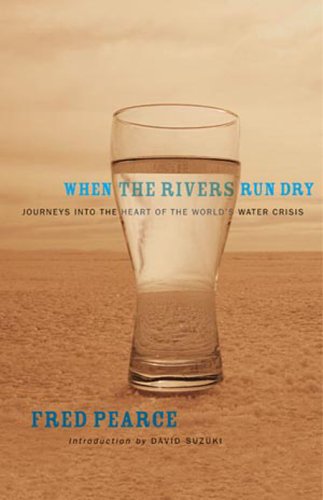
BOOK REVIEW: When the Rivers Run Dry by Fred Pearce

“Water, water, everywhere, Nor any drop to drink.” Rime of the Ancient Mariner – Samuel Taylor Coleridge

Fred Pearce has been writing and consulting on environmental issues for decades. A highly respected and internationally acclaimed science writer, his newest book, When the Rivers Run Dry: Journeys into the Heart of the World’s Water Crisis, addresses the issue that many scientists contend will be the cause of future world conflicts – the world is running out of water. Earth is awash with water; however, usable water is at a premium. The last sentence of Pearce’s introduction states: “Water, after all, is the ultimate renewable resource.” The question therefore becomes: How is it possible that we are using more water than can be renewed?

Pearce’s contention is that the Western water “footprint” on the rest of the world is a major problem. On average, the water used to feed and clothe most of us for a year takes between 1,500 and 2,000 tonnes, more than half the contents of an Olympic-sized swimming pool. As most of what we eat and wear is grown and manufactured in other countries, we are importing vast quantities of what economists refers to as “virtual water.” What we wear and eat influences the hydrology of producer regions, resulting in a yearly global trade estimated at a thousand cubic kilometers - twenty River Niles.

The small measures we take each day, using low flush toilets or turning off the water while we brush our teeth, while useful on a local scale, have little influence on the majority of water usage. In a system where 11,000 litres are needed to produce the patty used in a McDonald’s Quarter-Pounder, a global solution must be found.

Pearce suggests that the countries currently undertaking massive irrigation projects for food production must reconsider their water usage, weighing the environmental impact of transportation against water depletion. Instead of turning deserts into agricultural land to grow wheat, in some cases using three times as much water as the global norm, countries need to consider importing wheat and other food crops from countries with a lower water cost. New economic models must be developed to consider the true cost of producing food.

When the Rivers Run Dry is an unflinching look at current water situation in more than 30 countries. Just three countries - India, China and Pakistan – account for the usage of more than half the world’s total use of underground water, one-sixth of the world’s usable water. Some of the world’s largest aquifers are under desert sands; however, these aquifers cannot be replaced by rain and in some cases the water being drawn from deep within the earth is thousands of years old. This water is a bank account we are draining dry, dooming the aquifers to extinction: “When a river runs dry, it is very visible. But underground water is invisible…and few in the corridors of power talk…about a slow-burning disaster that will one day affect hundreds of millions of people.” When the water in the world’s aquifers fails, food shortages will follow, undermining the world’s ability to feed itself.

Pearce puts forward that “water flows uphill to money.” If we hope to weather a global climate certain to become more extreme with shifting patterns of precipitation, the world’s governments must stop focusing on the money and instead look at the best interests of the world’s rivers, wetlands and aquifers. Attention must be paid to deteriorating municipal water systems and investments made to fix the potable water leaking into the ground; in some cities, as much as 40% of a city's potable water disappears this way. New attention must be paid to traditional methods of living in harmony with the world’s rivers rather than attempting to tame the rivers through dams and man-made irrigation channels. Desalination of water from the oceans, for agricultural use is still an incredibly cost-prohibitive undertaking.

As David Suzuki states in the foreword: “This...is an urgent warning and a call for action that we must not ignore.” Pearce has delivered a difficult message that should be required reading for all concerned citizens.

Fred Pearce is an environmental and development consultant at New Scientist. Writing about environmental and water issues for more than twenty years, his next book, With Speed and Violence: Why Scientists Fear Tipping Points in Climate Change, is scheduled for release in February 2007.

See the review at ReadySteayBook - When the Rivers Run Dry.

Wednesday, May 24, 2006

BOOK REVIEW: It's the Crude, Dude: war, big oil, and the fight for the planet

This review has been submitted to Alternatives Journal but I do not know when/if it will be included in their publication.

The Iraq Invasion as Smokescreen: Fight for Democracy or Oil?
It’s the Crude, Dude: war, big oil, and the fight for the planet, Linda McQuaig, Toronto: Anchor Canada, 2004, revised and updated 2005.


“…the Middle East, with 2/3 of the world’s oil and lowest cost, is still where the prize ultimately lies.” Dick Cheney, November 1999

Linda McQuaig, a journalist well-known for taking pokes at the big myths, now focuses on the largest. In It’s the Crude, Dude: War, Big Oil, and the Fight for the Planet, McQuaig aims squarely at the debate no one is having - Why was information on Iraq’s weapons of mass destruction falsified and why did the United States want to invade Iraq? During the 18 months since the falsification came to light, no commission or committee has been convened to investigate. It’s the Crude, Dude is an attempt to bring into perspective the US’s actions in Iraq by positioning them within the historical perspective of their behaviour in the Middle East, and their quest to control the world’s oil resources.

McQuaig posits that the Iraq invasion was already planned to serve the interests of Big Oil when Cheney was still CEO of Haliburton. Once George W. Bush took office, two key policies to benefit the oil industry were immediately implemented: withdrawal from the Kyoto Accord and the beginning of the invasion of Iraq. Bush and Cheney have continually put the interests of Big Oil before those of democracy, global law and the American citizen. The “war on terror” has provided the smokescreen of “national security”, creating the illusion that there are no competing interests at work within Bush’s administration.

The oil shortage has already begun, mostly unacknowledged by officials, and, thanks to NAFTA, Canada gave up its right to reduce oil exports to the US, unless we reduce our own consumption by the same amount. McQuaig believes this wake-up call needs to be heeded and the reliance on oil reduced if Canada hopes to weather the coming war between China (second in oil consumption) and the US over oil.

At a time when the world’s focus should be finding renewable energy sources and environmental conservation, the current US administration is rolling back environmental protections and promoting reliance on oil.

McQuaig doesn’t put forward anything Canadians don’t already know or suspect. It’s the Crude, Dude provides a starting point for the discussions that must happen, framing the research and statistics in a clear, concise manner understandable by the average concerned citizen.

Saturday, April 15, 2006

Non-Fiction Book Reviews - Master List

In an effort to reduce the long list of reviews in my sidebar, I decided to create an entry of each of the category of books I review. That way I can update this entry and link to just this entry in the sidebar.

This is a list of the non-fiction books I've reviewed, alphabetical by author.

* Jane Jacobs: Urban Visionary - Alice Sparberg Alexiou

* Abode of Love: Growing Up in a Messianic Cult - Kate Barlow

* Every Book Its Reader: The power of the printed word to stir the world – Nicholas A. Basbanes

* The City of Falling Angels - John Berendt

* My Life as a Furry Red Monster - Kevin Clash

* Grayson - Lynne Cox

* Pursuing Giraffe: a 1950s Adventure - Anne Innis Dagg

* The Weather Makers: How We Are Changing the Climate and What It Means for Life on Earth - Tim Flannery

* Kristallnacht: Prelude to Destruction - Martin Gilbert

* Secrets of a Satisfying Life: discover the habits of happy people - David D. Ireland

* The Intellectual Devotional: Revive Your Mind, Complete Your Education, and Roam Confidently with the Cultured Class - David S. Kidder & Noah D. Oppenheim

* Every Mother is a Daughter: the neverending quest for success, inner peace, and a really clean kitchen (recipes and knitting patterns included)- Perri Klass & Sheila Solomon Klass

* Path of Destruction: the devastation of New Orleans and the coming age of superstorms - John McQuaid & Mark Schleifstein

* It's the Crude, Dude: war, big oil, and the fight for the planet - Linda McQuaid

* The Things That Matter: what seven classic novels have to say about the stages of life - Edward Mendelson

* Time was Soft There: a Paris sojourn at Shakespeare & Co. – Jeremy Mercer

* The Pulpwood Queens' Tiara-Wearing, Book Bearing Guide to Life - by Kathy Patrick

* When the Rivers Run Dry: Journeys into the Heart of the World's Water Crisis – Fred Pearce

* The Secrets of Judas: the story of the misunderstood disciple and his lost gospel - James M. Robinson

* The Mural at Waverly Inn - Edward Sorel and Dorothy Gallagher

* You Can't Win If You Don't Enter - Carolyn Wilman