Saturday, January 20, 2007

BOOK REVIEW: Un Lun Dun by China Miéville

Zanna and her friend Deeba have been noticing a lot of strange events lately. There was the fox that intently watched them on the playground and then bowed to Zanna. Certainly the oddest was the umbrella that dragged itself from a rubbish heap to hang from Zanna’s bedroom windowsill. The girls give chase to the umbrella and find themselves in a strange place called Un Lun Dun, a funhouse version of their own city. This new place is filled with animated milk cartons, unbrellas, talking books and flying double-decker buses, as well as with an odd collection of people.

Shortly after their arrival in Un Lun Dun they meet Obaday Fing, a tailor whose head is a massive pin-cushion, and Brokkenbroll, king of broken unbrellas. Zanna is disturbed to find out she’s the Shwazzy - the Chosen One – prophesied to save Un Lun Dun from a great evil, the Smog.

All goes terribly wrong when Zanna is injured soon after their arrival. She’s returned safely home but Un Lun Dun seems doomed. Deeba may be the only hope for this fantastical city, but will Un Lun Dun accept the help or the unchosen one, or lie down and accept its fate?

Award-winning author China Miéville’s fifth novel, Un Lun Dun, is his first written for the young adult market and is filled with his illustrations of the mysterious creatures met by Zanna and Deeba. While this book is being marketed to middle and high school students, there is much here to recommend this book to adult readers. Fans of the films of Jan Švankmajer, specifically his 1988 film Alice, will find familiar elements in the world of Un Lun Dun.

Miéville, as well-known for his politics as for his writing, is a member of the Socialist Workers Party. His writing has indications of his political leanings; however, he has stated that: “…when I write my novels, I’m not writing them to make political points.…but because I come at this with a political perspective, the world that I’m creating is embedded with many of the concerns that I have...”

Un Lun Dun is sure to win Miéville many new fans and delight current ones.

Read the review at Armchair Interviews.


ISBN10: 0345495160
ISBN13: 9780345495167

Hardcover
448 Pages
Publisher: Del Rey Books
Publication Date: February 17, 2007


tags:

Friday, January 19, 2007

Hyperion Books - Spring/Summer 2007 Titles

Here are my picks from Hyperion Books' Spring and Summer titles. A number are the trade paperback releases of books which were released in hardcover last year, so hopefully new readers will discover some great reads.

* Queen of Broken Hearts: A Novel by Cassandra King (February 2007)
* The Master Plan: Himmler's Scholars and the Holocaust by Heather Pringle (Trade Paperback, February 2007)
* A Model Summer: A Novel by Paulina Porizkova (April 2007)
* Not on Our Watch: A Mission to End Genocide in Darfur and Beyond by Don Cheadle and John Prendergast (May 2007)
* Grief: A Novel by Andrew Holleran (Trade Paperback, June 2007)
* The Late Bloomer's Revolution: A Memoir by Amy Cohen (July 2007)

Thursday, January 18, 2007

BOOK REVIEW: Spinning Dixie by Eric Dezenhall

Presidential Press Secretary and professional spinmeister Jonah Eastman commits hari-kari after commenting on a Yemen-born suicide bomber who killed himself and 24 football fans: “It’s hard to believe Western civilization is going to be taken down by a bunch of cabdrivers.” While his career is in a nosedive, his recent loose lips leave him free to help the mysterious blond who shows up at the White House gates carrying a letter from his teenage love Claudine Polk.

Jonah hies off to Tennessee to help save Claudine’s beloved family plantation, Rattle & Snap, from his teenage nemesis and Claudine’s soon-to-be ex-husband J.T. Hilliard. Can this Yankee spin-doctor help his southern belle start a second civil war and perhaps save his own future at the same time?

Billed as a blending of The West Wing, Gone with the Wind and The Godfather, Spinning Dixie is the fourth Eric Dezenhall novel to feature Jonah Eastman. Spinning Dixie, while on the surface a novel about politics and spin, is a novel about first love and the compelling force it can have even 25 years later. Alternating between the summer after Jonah’s senior year in high school and the present, Dezenhall has created a scenario certain to unleash havoc – a New Jersey kingpin’s grandson in Tennessee wooing the granddaughter of a Confederate general on her family’s plantation.

Not having read any of previous three novels, it was difficult to determine where Spinning Dixie fits into Jonah’s story. The novel stands on its own and is chock-full of characters certain to steal readers’ attention: Jonah’s flamboyant grandmother DeeDee; Claudine’s little brother Six; or “the Panamanian,” a colleague of Jonah’s who specializes in intelligence work.

The most compelling sections of this novel are the parts from Jonah’s teenage years. Dezenhall has captured the dichotomy of youthful passion; the hopefulness and sense of wonder, the undercurrent of doom and the inevitable painful ending. The tension between Jonah and Claudine’s worlds turn their romance into one of epic proportions, the doomed romance which has the power – even 25 years later – to draw Jonah back into Claudine’s sphere.


ISBN10: 031234063X
ISBN13: 9780312340636

Hardcover
336 Pages
Publisher: St. Martins Press
Publication Date: December 26, 2006
Author Website: www.dezbooks.net


tags:

Monday, January 15, 2007

What did you read in high school?

A friend who is in teacher's college sent me a message asking if I would fill out a survey for one of her classes. What she wanted was for me to think back to high school and try to remember the books I studied from grade 7 through to the end of high school.

What's interesting is that I have no memory of the books read in grade 7 or 8 at all, and little memory of the books in grades 12 & 13. (Yes, I was in high school when Ontario still had grade 13. It certainly gives readers a better picture of my age!)

So this got me thinking. I can't figure out why I remember the books we read in grades 9 - 11 books clear as a bell, while I remember what I was reading outside of school for the rest of the yearw.

I was at a private high school and our Shakespeare plays were chosen each year depending what was playing at Stratford. We would read the play, watch the movie version and then go see it live. I know which Shakespeare plays we studied, just not which grade I read it in.

Grade 9 - Things Fall Apart by Chinua Achebe, Cry the Beloved Country by Alan Paton, Who Has Seen the Wind by W.O. Mitchell, Animal Farm by George Orwell
Grade 10 - The Pearl by John Steinbeck, The Chrysalids by John Wyndham, Old Man and the Sea by Ernest Hemingway, Lord of the Flies by William Golding
Grade 11 - The Sound and the Fury by William Faulkner, As for Me and My House by Sinclair Ross, The Great Gatsby by F. Scott Fitzgerald
Grade 12 - Tess of the D'Ubervilles by Thomas Hardy, Wuthering Heights by Emily Bronte (can't remember the rest of the books)
Grade 13/OAC - The Stone Angel by Margaret Laurence (can't remember the rest of the books)

Shakespeare:
As You Like It
King Lear
The Tempest
Macbeth
Hamlet

So how closely does my high school reading list match up with yours? Do you remember what you read then, or do you have clearer memories of your "non-school reading?"

Sunday, January 14, 2007

Simon & Schuster - Spring 2007 Titles

Too often publishers appear to publish most of their titles in the fall in anticipation of the holiday buying season. I was therefore pleased to find most of the publishers have strong spring lines with an interesting range of titles.

Simon & Schuster don't have a lot of well-known authors in their spring 2007 line; however, there are some great treasures to be found for readers willing to take time with their catalogue. Here are my picks for the spring season:

* Him Her Him Again The End of Him by Patricia Marx (January 2007)
* The Night Buffalo: A Novel by Guillermo Arriaga (February 2007)
* Looks to Die For by Janice Kaplan (February 2007)
* A Family Daughter: A Novel by Maile Meloy (February 2007)
* Broken Paradise: A Novel by Cecilia Samartin (February 2007)
* The Secret Supper: A Novel by Javier Sierra, Translated by Alberto Manguel (February 2007)
* The Lying Tongue by Andrew Wilson (February 2007)
* The Spellman Files: A Novel by Lisa Lutz (March 2007)
* The Rossetti Letter by Christi Phillips (March 2007)
* The Expected One: A Novel by Kathleen McGowan (Trade Paperback, April 2007)
* The Killing Jar: A Novel by Nicola Monaghan (April 2007)


tags:

Wednesday, January 10, 2007

Raincoast Books - Spring/Summer 2007 Titles

Raincoast Books is a Canadian publisher and distributor producing a wide range of fiction and non-fiction titles for adults and children. They distribute many well-known imprints in Canada including: Bloomsbury UK, Chronicle Books, Harcourt (HBJ), & Hesperus Press, as well as many others. A full list is available on their website.

The following titles (my picks) are listed by publication date rather than by publisher, except for Hesperus Press.

Raincoast Books
* Paris: the secret history by Andrew Hussey (Bloomsbury USA, January 2007)
* Audrey Hepburn: the Paramount years by Tony Nourmand (Chronicle Books, January 2007)
* Loyal to the Sky: Notes from an Activist by Marisa Handler (Berrett-Koehler Publishers, February 2007)
* If Minds Had Toes by Lucy Eyre (Bloomsbury UK, March 2007)
* Linger Awhile by Russell Hoban (Bloomsbury UK, New Format, March 2007)
* A Book Addict's Treasury by Lynda Murphy and Julie Rugg (Frances Lincoln, March 2007)
* White Man Falling by Mike Stocks (Alma Books, March 2007)
* Welcome to Everytown: a journey into the English mind by Julian Baggini (Granta Books, April 2007)
* Pretty in Punk: 25 Rock, Goth, and Punk inspired knitting projects by Alyce Benevides and Jaqueline Milles (Chronicle Books, April 2007)
* Untapped: the scramble for Africa's Oil by John Ghazvinian (Harcourt, Inc., April 2007)
* Divas Don't Knit by Gil McNeil (Bloomsbury UK, April 2007)
* Return to Akenfield: portrait of an English village in the 21st Century by Craig Taylor (Granta Books, Trade Paperback, April 2007)
* The Nature of Monsters: a novel by Clare Clark (Harcourt, Inc., May 2007)
* The Catastrophist: a novel by Lawrence Douglas (Harcourt, Inc., May 2007)
* The Gravedigger: a novel by Peter Grandbois (Chronicle Books, May 2007)
* Volunteer: a traveller's guide to making a difference around the world by Lonely Planet (Lonely Planet, June 2007)
* The Pantry: its history and modern uses by Catherine Seiberling Pond (Gibbs Smith, May 2007)
* When We Get There: a novel by Shauna Seliy (Bloomsbury USA, May 2007)
* Virgins: a cultural history by Anke Bernau (Granta Books, June 2007)
* Austenland: a novel by Shannon Hale (Bloomsbury USA, June 2007)
* Becoming Shakespeare: how a provincial playwright became the world's foremost literary icon by Jack Lynch (Walker & Company, June 2007)
* Sugarcane Academy: how a New Orleans teacher and his storm-struck students created a school to remember by Michael Tisserand (Harcourt, Inc., July 2007)
* The Museum of Dr. Moses: tales of mystery and suspense by Joyce Carol Oates (Harcourt, Inc., August 2007)

Hesperus Press
* The Watsons by Jane Austen (March 2007)
* Sanctuary by Edith Wharton (March 2007)
* Cousin Phillis by Elizabeth Gaskell (April 2007)
* The Calligraphers' Night by Yasmine Ghata (June 2007)
* A Simple Story by Leonardo Sciascia (June 2007)


tags:

Monday, January 08, 2007

Henry Holt & Company - Spring/Summer 2007 Titles

Here are my picks from Henry Holt & Company's Spring and Summer titles. Some exciting books are being released in trade paperback from Owl Books and I would highly recommend Disaster: Hurrican Katrina and the failure of Homeland Security by Christopher Cooper and Robert Block.

Henry Holt
* The Short Bus: a journey beyond normal by Jonathan Mooney (June 2007)
* My Colombian War: a journey through the country I left behind by Silvana Paternostro (July 2007)
* The Master Bedroom: a novel by Tessa Hadley (August 2007)
* Letter from Point Clear: a novel by Dennis McFarland (August 2007)

Metropolitan Books
* Helpless: a novel by Barbara Gowdy (April 2007)
* Inglorious: a novel by Joanna Kavenna (June 2007)

Owl Books
* Book by Book: notes on reading and life by Michael Dirda (Trade Paperback, May 2007)
* Brutal Journey: Cabeza de Vaca and the epic first crossing of North America by Paul Schneider (Trade Paperback, May 2007)
* Disaster: Hurrican Katrina and the failure of Homeland Security by Christopher Cooper and Robert Block (Trade Paperback, June 2007)


tags:

Saturday, January 06, 2007

BOOK REVIEW: Slow Man by J.M. Coetzee

In a suburban neighbourhood of Adelaide, Australia, a cyclist is knocked off his bicycle, a small act with far-reaching consequences. When Paul Rayment opens his eyes, he is immediately required to give consent to the operation that will amputate his leg at the knee. Refusing to consider using a prosthesis, and profoundly uncomfortable to be reliant on others, Paul returns home under the care of a string of nurses. It is only with the arrival of Marijana Jokić - a Croatian nurse - that Paul’s life begins to turn around and he falls in love with his down-to-earth caregiver. That is until Elizabeth Costello arrives on his doorstep; an unstoppable force who demands Paul take an active role in his own narrative and accept responsibility for his actions.

Slow Man, J.M. Coetzee’s first novel since his Nobel Laureate win in 2003, is his latest meditation on care, aging and the nature of existence. The “slowed man” of the title, Paul Rayment, finds himself both physically slowed by the accident and mentally slowed by depression and an inability to accept his new reality. Elizabeth Costello’s arrival (the titular character of Coetzee's 2003 novel) and machinations are designed to force Paul out of his slowness by holding a mirror before him. She questions his motivations and demands that he face the roots of his desire for Marijana: is it his desire for love; his desperation to leave a legacy; or a fear of his own mortality which drives his desire to take Marijana and her children as his own family.

The Observer (UK) suggests that, rather than Elizabeth intruding into Paul’s novel, he has intruded into hers. “She explains her presence by quoting to Paul the opening section of his novel [Slow Man], the bike and him flying through the air and so on. Far from intruding on his novel, she suggests, he has intruded on hers: “You came to me [Paul], that is all I can say. You occurred to me, a man with a bad leg and no future and an unsuitable passion ... where we go from there I have no idea. Have you any proposal?”

When Marijana shares her fears for her son Drago, Paul offers to pay for Drago’s schooling. Rather than the “help” Paul believes he is providing, in reality he is forcing himself into Marijana’s world the same way Elizabeth has forced herself into his. The consequences of this act of misguided charity ripple throughout the rest of the novel, reinforcing Coetzee’s key point on motivation. Elizabeth points out repeatedly that, no matter what the motivation behind an action, one is still responsible for the fallout – a lack of self-awareness or premeditation does not relieve one of guilt or responsibility.

A meditation on loss, motivation and the creative process, Slow Man is a thought-provoking work raising more questions than it answers. Coetzee’s spare prose is brilliantly exhibited here; however, this is not one of his more accessible works. The bickering dialogue between Elizabeth and Paul, a post-modern meditation on the creative process will not appeal to all readers. A first-time reader of J.M. Coetzee will have a better introduction to his skillful writing through reading Disgrace or Life & Times of Michael K.

Read the review at Curled Up with a Good Book.


ISBN10: 0143037897
ISBN13: 9780143037897

Trade Paperback
264 Pages
Publisher: Penguin
Publication Date: October 2006


tags:

Wednesday, December 27, 2006

BOOK REVIEW: The Rhythm of the Road by Albyn Leah Hall

Josephine Pickering has grown up on the highways of the United Kingdom, in her father Bobby's rig. Abandoned by his wife shortly after Jo’s birth, Bobby took to the road with his baby daughter. A Northern Irishman, Bobby was a country musician before he became a father and he passed his love of country music and the open road on to his daughter.

When Jo is twelve, her father stops to give hitchhiker Cosima Stewart a lift. Cosima, lead singer of Cosima Stewart and Her Goodtime Guys, quickly becomes an idol to Jo, although over time the idolization turns into obsession. When Bobby finally gives in to the depression which has haunted him for years, Jo follows Cosima’s band to America where she must finally confront the truth about her life and the choices she’s made.

Albyn Leah Hall’s debut American novel, The Rhythm of the Road is a quiet work; full of teenage angst, the desperation to belong and a search for meaning. Hall has created a strong voice for this young woman seeking roots and a place to belong and Jo’s agony is almost painful to experience. While Jo’s spiral out of control is violent at times, Hall never lets the reigns slip from her firm grasp, ensuring that Jo remains an empathetic character.

Although The Rhythm of the Road is the story of Jo’s development into a woman, by far the strongest character is Bobby. His quiet strength balances Jo and Cosima; however, it is the buried pain and words he doesn’t share which remain with the reader. While Hall’s writing in The Rhythm of the Road is at times uneven, she has a manner of character development which means she is a writer to watch.


ISBN10: 0312359446
ISBN13: 9780312359447

Hardcover
304 Pages
Publisher: Thomas Dunne Books
Publication Date: January 9, 2007
Author Website: www.albynleahhall.co.uk


tags:

Tuesday, December 26, 2006

BOOK REVIEW: Warrior and Witch by Marie Brennan

When a witch is born, a doppelganger is also created. In order for a witch to gain control of those powers, her doppelganger must be destroyed according to traditions passed down for generations. Mirei, a blending of Miryo (witch) and Mirage (warrior), is the most powerful witch alive. Instead of killing Mirage, Miryo merged with her doppelganger, and her acceptance within the hallowed halls of Starfall has wrecked havoc within the political and religious structure of this closed society.

Viewed by many as an abomination, Mirei’s very existence has created a schism and war has been declared between the rival factions. Now, Mirei is in a race to reach the hidden doppelgangers and ensure they have a chance to merge with their other halves; while trying to discover the extent of her new powers and discover the fate of Eclipse, Mirage’s hunting partner and her true love.

Warrior and Witch commences shortly after the closing pages of Doppelganger, Marie Brennan’s first novel. While readers can enjoy Warrior and Witch without having read its predecessor, the experience will not be as immersive. Brennan’s interest in cultural anthropology is evident in the depth and complexity of the world she created. The history behind the traditions and social structures are explained in the first novel, although keen readers will quickly understand that the warrior traditions owe a nod to martial arts training.

Brennan states on her website that she has no further plans for novels within this world; however, the culture she has described is so vibrant that many windows are still open - if she chooses to return.

Marie Brennan (the pen name of Bryn Neuenschwander) is a graduate student in cultural anthropology and folklore at Indiana University at Bloomington, studying fantasy and science fiction. Her studies focus both on the media manifestations of fantasy and science fiction, as well as on the communities which spring up around them.

Read an excerpt here.

ISBN10: 0446616974
ISBN13: 9780446616973

Mass Market
464 Pages
Publisher: Warner
Publication Date: October 1, 2006
Author Website: swantower.com


tags:

Saturday, December 16, 2006

Random House - Winter/Spring 2007 Titles

Random House is the distributor for some of my favourite UK imprints; most notably Harvill Secker and Chatto & Windus. They also have a number of other important imprints. So with a period covering 6 months, it shouldn't be surprising that my picks comprise such a long list.

I haven't had a close look at their non-fiction offerings, so this list is mostly adult fiction. A number of notable books are being released in trade paperback over the next few months and, for those I listed as picks last summer, I've included them here again.

Note: Books marked with the "%" symbol are books I reviewed in hardcover. The link will take you to the blog entry of my review.

Anchor
* The Day Watch by Sergei Lukyanenko (January 30, 2007)
* The Unbinding by Walter Kirn (January 30, 2007)
* The Mysterious Secret of the Valuable Treasure: Curious Stories by Jack Pendarvis (February 6, 2007)
* Poppy Shakespeare by Clare Allan (Trade Paperback, April 10, 2007)
* The Attack by Yasmina Khadra (May 8, 2007)
* The Stolen Child by Keith Donohue (Trade Paperback, May 8, 2007) %

Ballantine Books
* Blood of Paradise: a Novel by David Corbett (March 6, 2007)
* Damsels Under Stress by Shanna Swendson (May 1, 2007)
* Summer Reading by Hilma Wolitzer (May 22, 2007)
* The Sonnet Lover: a Novel by Carol Goodman (June 12, 2007)

Bantam
* Sixty Days and Counting by Kim Stanley Robinson (February 27, 2007)
* The Hindi-Bindi Club: a Novel with Recipes by Monica Pradhan (May 1, 2007)

Bond Street Books
* The Reluctant Fundamentalist by Mohsin Hamid (April 24, 2007)

Broadway Books
* French by Heart: An American Family's Adventures in La Belle France by Rebecca S. Ramsey (April 24, 2007)
* The Book of Jane by Anne Dayton & May Vanderbilt (June 12, 2007)

Chatto & Windus
* Death of a Salaryman by Fiona Campbell (April 27, 2007)

Crown
* The Secret Magdalene: a novel by Ki Longfellow (March 27, 2007)
* Adventures of an Italian Food Lover: With Recipes from 213 of My Very Best Friends by Faith Willinger (April 3, 2007)
* The Five-Forty-Five to Cannes by Tess Uriza Holthe (May 8, 2007)
* Plenty: One Man, One Woman, and a Raucous Year of Eating Locally by Alisa Smith and J.B. MacKinnon (May 15, 2007)
* Deer Hunting with Jesus: Dispatches from America’s Class War by Joe Bageant (June 12, 2007)
* Mary Modern: a Novel by Camille Deangelis (July 10, 2007)
* The Water's Lovely: a Novel by Ruth Rendell (July 17, 2007)

Del Rey
* Ink: the Book of All Hours by Hal Duncan (February 27, 2007)
* The Music of Razors by Cameron Rogers (May 1, 2007)
* Maledicte by Lane Robins (May 29, 2007)

Delacorte Press
* The Blood Spilt by Åsa Larsson (January 30, 2007)
* All Saints by Liam Callanan (February 27, 2007)

Dial Press
* Send Me by Patrick Ryan (January 30, 2007)
* Paradise Park by Allegra Goodman (Reissue, March 17, 2007)
* Cellophane by Marie Arana (May 1, 2007)
* The Archivist's Story by Travis Holland (May 1, 2007)

Doubleday Canada
* Overture: a Novel by Yael Goldstein (January 16, 2007)
* The End of the Alphabet by CS Richardson (January 23, 2007)
* Death Comes For the Fat Man: A Dalziel and Pascoe Mystery by Reginald Hill (March 6, 2007)
* The Color of a Dog Running Away by Richard Gwyn (March 20, 2007)
* Rant: The Oral History of Buster Casey by Chuck Palahniuk (May 1, 2007)
* Three Bags Full by Leonie Swann (June 5, 2007)
* The Night Ferry by Michael Robotham (June 12, 2007)

Harvill Secker
* Montano by Enrique Vila-Matas (January 23, 2007)
* Nada by Carmen Laforet (February 27, 2007)

Knopf
* Adam Haberberg by Yasmina Reza (January 2, 2007)
* A Handbook to Luck by Cristina Garcia (April 10, 2007)
* The Ministry of Special Cases by Nathan Englander (April 24, 2007)

Little Bookroom
* Literary St. Petersburg by Elaine Blair (May 1, 2007)

Nan A. Talese
* The Fabric of Night: A Novel by Christoph Peters (January 9, 2007)
* Delirium by Laura Restrepo (March 20, 2007)
* The Sirens of Baghdad: a Novel by Yasmina Khadra (May 8, 2007)

NYRB Classics
* That Awful Mess on the Via Merulana by Carlo Emilio Gadda (Reissue, February 27, 2007)
* Enchanted April by Elizabeth von Arnim (Reissue, April 3, 2007)
* The Slynx by Tatyana Tolstaya (Reissue, April 17, 2007)

Random House
* Still Water Saints by Alex Espinoza (January 30, 2007)
* Radiance by Shaena Lambert (February 13, 2007)
* Absurdistan by Gary Shteyngart (Trade Paperback, April 3, 2007)
* No Humans Involved by Kelley Armstrong (May 1, 2007)
* A Death in Vienna by Frank Tallis (May 8, 2007)
* Tom Bedlam: a Novel by George Hagen (June 5, 2007)

Shaye Areheart Books
* The Prince of Nantucket: a novel by Jan Goldstein (April 24, 2007)
* A Good and Happy Child by Justin Evans (May 22, 2007)

Three Rivers Press
* The Moonlit Cage: A Novel by Linda Holeman (March 27, 2007)
* 13 Bullets: a Vampire Tale by David Wellington (May 22, 2007)
* To Dance with Kings: a Novel by Rosalind Laker (May 22, 2007)
* Dark Angels: a Novel by Karleen Koen (May 29, 2007)
* Wish Club by Kim Strickland (May 29, 2007)
* Turning the Tables: A Novel by Rita Rudner (June 26, 2007)

Vertical
* The Cat in the Coffin by Mariko Koike (June 5, 2007)

Villard
* There's a Slight Chance I Might be Going to Hell by Laurie Notaro (May 29, 2007)

Vintage Canada
* The Brief History of the Dead by Kevin Brockmeister (Trade Paperback, January 9, 2007)
* Lost Echoes by Joe R. Lansdale (February 13, 2007)
* The Truth About Sascha Knisch by Aris Fioretos (February 27, 2007)
* The Lizard Cage by Karen Connelly (Trade Paperback, March 6, 2007)
* The City of Dreaming Books by Walter Moers (Trade Paperback, March 27, 2007)
* Giraffe by J.M. Ledgard (Trade Paperback, March 27, 2007)
* Suite Francaise by Irene Nemirovsky (Trade Paperback, April 10, 2007)
* The Dead Fish Museum by Charles D'Ambrosio (Trade Paperback, April 10, 2007) %
* By the Time You Read This by Giles Blunt (Trade Paperback, May 8, 2007)

William Heinemann
* Nine Nights by Bernardo Carvalho (February 27, 2007)
* Cupid's Darts by David Nobbs (March 27, 2007)
* Forgotten Dreams by Katie Flynn (May 22, 2007)
* A Most Dangerous Woman by Lee Jackson (May 22, 2007)


tags:

Friday, December 15, 2006

Faber & Faber titles from early 2007

Faber & Faber has some great upcoming titles, including the trade paperback version of Milan Kundera's newest book.

Here are my picks from their winter/spring line.

* Imposture by Benjamin Markovits (January 2007)
* Utopian Dreams by Tobias Jones (January 2007)
* Sir Gawain and the Green Knight translated by Simon Armitage (January 2007)
* The Observations by Jane Harris (February 2007)
* A Night at the Majestic: Proust & the Great Modernist Dinner Party by Richard Davenport-Hines (February 2007)
* The Amnesiac by Sam Taylor (March 2007)
* In Search of a Distant Voice by Taichi Yamada (March 2007)
* Beowulf (Bilingual Edition) translated by Seamus Heaney (March 2007)
* The Curtain by Milan Kundera (Trade Paperback, March 2007)
* Jack the Lad and Bloody Mary by Joseph Connolly (April 2007)
* Seizure by Erica Wagner (April 2007)

Thursday, December 14, 2006

BOOK REVIEW: The Thirteenth Tale by Diane Setterfield

Vida Winter, one of Britain’s best-loved novelists, is known for her reluctance to share the truth of her life story. Having spent the past six decades creating outlandish stories, Vida is facing death and wishes to leave the truth as her legacy.

Margaret Lea is surprised to receive the request from Miss Winter, an author she’s never spoken to, asking her to act as biographer. Margaret has published a few articles on lesser known author but is unable to fathom why an author of such reknown would choose her. In an effort to learn more about her potential subject, Margaret picks up her father’s rare copy of Thirteen Tales of Change and Desperation and is mesmerized by the stories. As she nears the end of the volume she is confronted by one of Britain’s biggest literary mysteries: where is the thirteenth tale? Margaret agrees to meet with Miss Winter and is quickly engaged in the unfolding story of her complex life and the destroyed estate of Angelfield.

Diane Setterfield’s debut novel The Thirteenth Tale rocketed up the best-seller lists soon after its release mid-September and many skeptics wondered how much of this success was due to aggressive online marketing efforts rather than its merit. This reviewer is pleased to report that, in her opinion, Setterfield’s success is due to a well-crafted plot, engaging characters and frequent nods to gothic novelists of the past.

The Thirteenth Tale centres around a story-within-a-story, as Vida recounts the family history leading up to her birth and beyond. All the elements of a gothic novel are found here; a mouldering old house, mental illness, twins, neglectful parents, a domineering governess, isolation and ghosts. Margaret, an exceptional narrator, is drawn into the action as she tries to substantiate Vida’s story, while battling the specters of her own past.

Initially Margaret is reluctant to be drawn in by Vida, maintaining a professional distance from her subject. Her research, and the parallels she sees between Vida’s and her own story, eliminate her defenses and, like a du Maurier or Brontë heroine, Margaret becomes consumed by the story around her.

Setterfield uses her descriptions of place to increase the readers’ understanding of her characters. Miss Winter has spent so many years suffocating the truth that “..the other rooms were thick with the corpses of suffocated words: here in the library you could breathe.” The library, Margaret’s domain, is the place of truth, therefore a place within which light and air preside.

Essentially, The Thirteenth Tale is about the battle between truth and fiction, and the consequences of each. Fiction is easier, as Miss Winter points out: “What succour, what consolation is there in truth, compared to a story?” As readers soon learn, there is a price for each and no simple line can be drawn in the sand.


ISBN10: 038566284X
ISBN13: 9780385662840

Hardcover
416 Pages
Publisher: Bond Street Books
Publication Date: September 12, 2006


tags:

Wednesday, December 13, 2006

BOOK REVIEW: Flora Segunda by Ysabeau S Wilce

Flora Segunda (or Flora the Second) has become the caretaker of her family’s home, Crackpot Hall, and her father ever since her mother banished the magickal butler. Whether Poppy or Crackpot Hall is more of chore is open to debate but at least Poppy is somewhat predictable. Crackpot Hall has eleven thousand rooms and they are prone to move around at random. Flora knows better than to step of the proven paths through her house but one morning she is really late for school so she chances a ride in the elevator and ends up lost in her on house.
Is it really fate that she stumbles upon the long-banished butler or is this the break she needs to have a normal life? With her best friend Udo, Flora is in a race to finish her Catorcena speech, look after Poppy, and find a way to break it to her mother that she isn’t going to follow the family tradition of entering the barracks. Could it really hurt to ask Valefor the butler for some help?

Following in the tradition of Patricia C. Wrede and Caroline Stevermer (Mislaid Magician or Ten Years After: Being the Private Correspondence Between Two Prominent Families Regarding a Scandal Touching the Highest Level), Flora Segunda: Being the Magickal Mishaps of a Girl of Spirit, Her Glass-Gazing Sidekick, Two Ominous Butlers (One Blue), a House with Eleven Thousand Rooms, and a Red Dog is a coming of age story wrapped within a traditional adventure story. Feeling both old-fashioned and post-modern, Ysabeau S. Wilce has combined elements of Eastern life (names which sound decidedly Eastern - such as Califa and Huitzil - and butlers who owe much to genies), as well as Asian traditions of warcraft and meditation. Interlacing these are elements of the western traditions of courtly love and elements of common to fantasy novels. Much here will provoke vague feelings of familiarity and in the early pages this becomes very distracting, as the reader keeps trying to find connections. The novel quickly grabs all the reader’s attention and the earlier distractions dissipate.

Wilce has a strong voice and distinctive style, which she exhibits with much aplomb in Flora Segunda. The titular heroine is delightful and readers will identify with her challenges and desire to carve her own path in life. Udo, the glass-gazing sidekick, provides the necessary balance to Flora Segunda and provides the right amount of frisson to add spice to the tale, but not distract from the main adventure.

Deliberate or not, Wilce has left herself room to develop Flora Segunda into a young adult series and this reviewer hopes that a follow-up novel will soon be available. Many interesting details of life within Califa have been introduced but not explored, such as the politics behind the current wars, why the Rangers were disbanded and what caused some of the great houses (families) to decline. Revelations made in the final pages also create many new avenues to explore within this captivating world.

Read an excerpt here.


ISBN10: 0152054332
ISBN13: 9780152054335

Hardcover
448 Pages
Publisher: Harcourt Children's Books
Publication Date: January 2007


tags:

Tuesday, December 12, 2006

BOOK REVIEW: The Book of Lost Things by John Connolly

Like many of the children in the fairy tales he adores, twelve-year-old David has lost everything. His beloved mother has died; his father has married Rose, a nurse from the hospital where his mother stayed during her illness, and started a new family. To escape the German bombs, they’ve moved out of London to the house where Rose grew up and David is installed in the attic room.

Filled with books from a previous occupant, David’s aerie appears to be part of the woods surrounding the house. Ivy has worked its way through the mortar and is spreading over the interior walls. Bugs are at home in his sock draw and spiders have taken over many of the room’s dark corners. Nature’s invasion is the least of his worries; David’s books have started talking and he is having attacks that leave him with peculiar memories of wolves and faded kings. After a particularly nasty row with Rose, David hears his mother’s voice begging him to rescue her and he follows the call into the darkness.

John Connolly’s The Book of Lost Things is the quintessential outsider tale. David has entered an unknown world when his father remarries and the family moves to a new home to escape the bombing of London. The move, close on the heels of the birth of Georgie, has David uncertain of his role within this new family group.

In typical fairy tale manner, the outsider embarks on a quest during which he/she endeavours to seek what has been lost. David hears his mother’s voice pleading with him to save her, providing him the opportunity to become a hero and leave behind the family he believes has no use for him.

Readers will find many familiar faces within the pages of The Book of Lost Things; however, that sense of familiarity will not last. In Connolly’s world, the forest holds cruel things that will include a lost child in a genetic experiment before eating them. Snow White didn’t ride off into the sunset with her prince and very few people live happily ever after.

Of course, what David is really seeking in the forest is himself. As divergent as Connolly’s book is from childish fairy tales, that morale centre is still present. David finds his inner strength and place within his family as he moves into adolescence. This is the expected outcome but the true ingenuity and magic in this adult tale is how Connolly reaches that ending.

Connolly has reinterpreted traditional tales, found the dark, secret core and created something fresh, new and exciting. By placing it during World War II, a time when childhood meant a gray world full of evil and very real horrors, the terrors of Connolly’s world loom in even starker contrast.

The Book of Lost Things marks a new direction in Connelly’s writing. If this reviewer’s experience is anything to go by, readers will be unable to set this book aside until David returns safely home.

Read the review at Curled Up with a Good Book.


ISBN10: 0743298853
ISBN13: 9780743298858

Hardcover
256 Pages
Publisher: Atria Books
Publication Date: November 2006


tags:

Friday, December 08, 2006

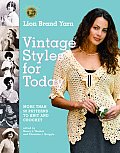
BOOK REVIEW: Lion Brand Yarn Vintage Styles for Today

Nancy Thomas and Charlotte Quiggle have combed the Lion Brand archives for patterns to reinterpret for today’s modern lifestyles. Lion Brand Yarn Vintage Styles for Today: more than 50 patterns to knit and crochet is the result, illustrating the company’s contribution to fashion over the last century.

To use vintage patterns to make modern garments, attention must be paid to sizing and fit. In the past, styles were more fitted with higher armholes, narrower waists and less ease. As the editors point out, “since our bodies are so different today from those of our forebears, whether because of undergarments or because of diet, any reference to “size” in a vintage pattern is relatively meaningless.”

Today, fit is looser and for some patterns in Lion Brand Yarn Vintage Styles for Today significant design changes have been made to create modern looks. One blanket, originally created as a baby item, has been redesigned in bulky yarn resulting in the stitch pattern now appearing as a modern leaf design.

The patterns in Lion Brand Yarn Vintage Styles for Today are evenly split between knit and crochet and all skill levels are covered. All patterns of course use Lion Brand yarns; however, the Standard Yarn Weight system icons are included for each pattern, allowing for yarn substitutions. Patterns cover the gamut from unusual shrugs to sweaters, layettes to something for man’s best friend – there is something here for everyone on your list.


ISBN10: 1400080614
Trade Paperback
192 Pages
Publisher: Potter Craft
Publication Date: January 24, 2006
Website: Lion Brand Yarns


tags:

Wednesday, December 06, 2006

Bookninja

A big Eclectic Closet shout-out to Bookninja for being featured tonight on The Arts Tonight with Eleanor Wachtel. The feature which ran just after 10 pm tonight should be posted in a few days on the Arts Tonight website so check it out if you get a chance.

Congratulations as well to Bookninja for winning the Canadian Blog Award for Best Entertainment Blog.

Tuesday, December 05, 2006

BOOK REVIEW: Famous Writers School by Stephen Carter

Famous Writers School is the grandiose name of Wendell Newton’s correspondence writing school. He seeks his students through advertisements in the back pages of literary magazines and what his students don’t realize is that Wendell is utterly lacking in talent. A former editorial staff member of America’s Farmer, his school is made up of a collection of unusual students. Rio is a torch singer and Ph.D. candidate with a penchant for confessional writing; Linda Trane is a housewife who may just be a stalking Wendell; and Dan, the only talented one in the bunch whose work has the potential to be published, if Wendell doesn’t steal his novel first.

Famous Writers School: a Novel is the second novel of Steven Carter (author of I was Howard Hughes). A send-up of correspondence courses for would-be writers, Carter chronicles the correspondence between a teacher and his students. Composed in an epistolary manner, the novel is made up of advertisements for the school, the welcome package sent out to lure in students and the lessons Wendell sends to his students. As the novel progresses, the reader is introduced to each of the students through their personal statements and writing assignments.

Wendell’s relationship to each student is different and it is through this interaction that the reader gains some understanding of his character. He is full of frustrations and self-important opinions and, rather than being annoying, he is a sympathetic loser. Carter possesses an understanding of the type of ego that drives Wendell and has painted him vividly for readers.

From the beginning it is obvious that the relationship between Dan and Wendell will be adversarial. Dan has the talent Wendell longs for and is seeking editorial advice Wendell is in no way equipped to give. Carter has portrayed this relationship most clearly in Famous Writers School. The relationships between Wendell and his other two students, while explored in some depth, do not possess the same resonance.

During one of his lessons, Wendell states: “True subtlety in fiction requires more than pyrotechnics with language; it requires that every sentence deliver the punch that is appropriate for the story at that particular moment and that leads to its inevitable conclusion.” Carter’s novel contains subtlety, he deftly maneuvers his plot without exposing his hand too early and he manages the novel’s pacing with a master’s skill.

Unfortunately, his obvious delight in playing with the epistolary method of novel construction becomes tedious with time and the novel’s strongest points are those when Carter sets aside his agenda and presents Dan’s “novel” in a straightforward manner.

Wendell is a character who remains with the reader long after the final page is read. Since reading Famous Writers School, this reviewer often hears his voice echoed when reading a particularly pompous piece of writing. This then, is perhaps the greatest compliment to be paid a writer – the knowledge that his creation lives on in the minds of readers.


Read an excerpt of Famous Writers School here.


ISBN10: 1582433569
ISBN13: 9781582433561


Hardcover
256 Pages
Publisher: Counterpoint
Publication Date: October 2006


tags:

Monday, December 04, 2006

BOOK REVIEW: Home Knits: Luxurious Handknits for Every Room of the House by Suss Cousins

Home Knits: Luxurious Handknits for Every Room of the House is the latest offering from Suss Cousins, author of two previous knitting books (Hollywood Knits and Hollywood Knits - Style). Best known for her yarn collection and designs for Hollywood movies (her latest project can be seen on Tim Allen in Santa Clause 3), in Home Knits Cousins designs 30 projects to bring her trademark style to your home.

When Cousins moved to a new home, she was inspired to create the designs in Home Knits. The designs combine the clean Swedish designs Cousins grew up with and mix old with new. Since she wanted to use a subdued colour palette, the designs in Home Knits have an emphasis on texture. In some projects, unusual materials are employed: curtain tiebacks are made using cotton twill tape and coasters are constructed out of jute twine; however, the rest of the patterns are made using Cousins’ line of yarn. Any of these designs can be made using other yarn and a helpful yarn substitution guide is included at the back of the book.

Home Knits has patterns for knitters of all skill levels for everything from pillows and napkin rings to bedspreads and wall hangings. Beginners will be tempted by the luxurious colours and textures of the Big Pillow Cover or the softness of the Luxurious Bedcover. More experienced knitters will be itching to knit up one of Cousins’ lampshades or her Ottoman Cozy. Experts will want to knit up the Kimono Robe in their favourite colour or be inspired to create their own piece of wall art.

Suss Cousins’ next book, Wedding Knits: Handmade Gifts for Every Member of the Wedding Party, will be published by Potter Crafts on January 2, 2007.


ISBN10: 0307335917
ISBN13: 9780307335913


Hardcover
160 Pages
Publisher: Potter Craft
Publication Date: November 2006
Author Website: sussdesign.com


tags:

Friday, December 01, 2006

BOOK REVIEW: The Saffron Kitchen by Yasmin Crowther

Maryam, the young daughter of an Iranian general, wants a different life than the one envisioned for her by her father. A man of influence, her father begins arranging a marriage for his beautiful sixteen-year-old daughter while Maryam longs for a life of adventure and to be a nurse. Her strong will and dreams cause her to be unsettled with her life and longing for freedome.

As violence erupts in her hometown, Maryam is left behind in the family compound and in her desperation she leaves safety to seek shelter with her father’s assistant Ali, for whom she secretly harbours feelings. Her return to the family home is noted by a family servant and - her secret out - she is summarily banished while Ali is brutally punished.

In present-day London, the arrival of Saeed, Maryam’s young nephew, sets off a chain of events whose roots extend back forty years. Maryam flees to her past in Iran leaving her daughter Sara behind to piece together long hidden secrets while caring for Saeed and her father.

Yasmin Crowther’s The Saffron Kitchen is set during the U.S.-backed 1953 coup that toppled Iran’s prime minister, Mossadegh. As the daughter of one of the Shah’s generals, Maryam’s willful behaviour causes shame for her father, an act which he is unable to forgive. His retribution is swift and fierce, setting off a deadly chain of consequences.

Maryam’s story is one of repression and a struggle for identity. Seeking a life different from that offered by her culture, she seeks a chance to be heard in a culture where her only value is as a bride and mother. “I thought of Zohreh, the deaf and dumb girl in Ehzat’s story and wondered whether I would ever be permitted to use the voice with which I had been born.”

Her punishment and subsequent banishment effectively silenced Maryam for decades. Even though she constructed a life in England and lived within a family, the violence in her history caused her to be cold and distant – a woman without country or identity.

Despite her history, Maryam’s belief that punishment made her strong and able to survive leads her to lash out at the weakness she perceives in Saeed. This act of aggression perpetuates the cycle of family violence and is the catalyst for change.

The Saffron Kitchen is told in the alternating voices of Sara and Maryam, moving through time to piece together Maryam’s fragmented story. The reader shares Sara’s quest to understand her mother and shares her anger at the wake of destruction which follows Maryam’s path.

Readers will feel horror at what Maryam lived through; however, Crowther makes the difficult choice to allow readers to feel outrage and anger toward her protagonist. Through this, Crowther forces readers to confront their own stereotypes and assess how individual choices affect family and friends, and eventually, to understand and accept Maryam’s decisions.

Yasmin Crowther shows exceptional promise with The Saffron Kitchen. It is difficult to fathom that such a strong voice is portrayed in a first novel. Where her inexperience shows is in balancing Maryam and Sara’s voices. Sara, unfortunately, is not an equal player and functions as a mechanism to move her mother’s story forward.

Read the review at Curled Up with a Good Book.


ISBN10: 0670038113
ISBN13: 9780670038114


Hardcover
272 Pages
Publisher: Viking Penguin
Publication Date: December 28, 2006 (United States)
(released in Canada in August 2006)


tags: